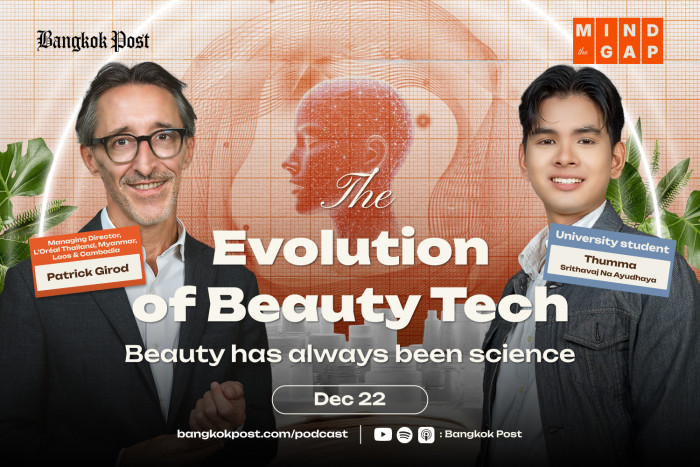
Beauty is in the eye of the beholder… and technology
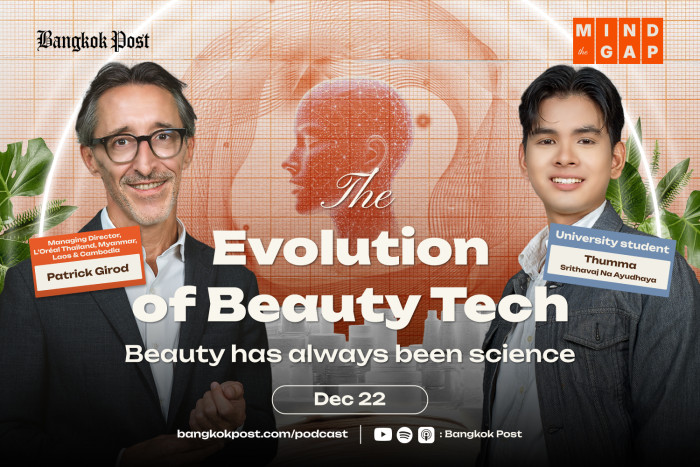
What happens when the romance of beauty meets the power of technology? In the ninth episode of the Bangkok Post’s Mind The Gap, “The evolution of beauty tech: Beauty has always been science”, two voices from opposite ends of the beauty industry come together to explore this question.
From ambition to authority, the episode connects a student standing at the threshold of the industry with a leader shaped by more than two decades at its forefront. Patrick Girod, Managing Director of L’Oréal Thailand, Myanmar, Laos and Cambodia, sits down with Thumma Srithavaj Na Ayudhaya, a third-year economics student at Chulalongkorn University, to discuss artificial intelligence (AI), the evolving global beauty landscape and practical guidance for those preparing to enter the workforce.
[embedded content]
When beauty meets science
The conversation opens with an unavoidable question: what role does AI play in beauty today? As Thumma raises the topic, Patrick is quick to point out that “the two worlds are not that far apart”.
Technology has long underpinned the beauty industry — from research and formulation to data-driven product development. With the rise of AI, this foundation deepens further, making offline shopping more immersive and personalisation more refined, moving towards ultra-personalisation.
Innovations such as Kiehl’s DermaReader exemplify this shift. By analysing 11 skin indicators, the tool can assess hydration levels, signs of ageing, and overall skin condition. As societies age, AI also enables more accurate predictions of how skin may change over time, leading to more targeted recommendations.
“AI allows us to diagnose more precisely and recommend products in a more relevant way,” Patrick explains. “When it enhances personalisation and prediction, its impact becomes extremely powerful.”
L’Oréal and beauty tech
At L’Oréal, Beauty Tech is not a future concept but a long-standing reality, shaping everything from consumer experiences to internal workflows. While virtual and augmented reality are visible to users, AI often works behind the scenes, quietly powering the wider ecosystem.
A key milestone came in 2018 with the acquisition of ModiFace, a Canadian leader in virtual try-on technology. This accelerated highly accurate digital experiences, allowing consumers to try lipstick shades or hair colours from home while enabling brands to gather richer data and deliver more precise visual results.
AI also blends seamlessly into everyday digital life. Through a partnership between Maybelline and Microsoft Teams, AI-powered makeup filters help users appear camera-ready during virtual meetings.
Internally, platforms such as L’Oréal GPT and Create AI Tech empower teams to generate brand-safe visuals and marketing assets quickly and securely, reducing reliance on external agencies and transforming how creative work gets done.
The qualities L’Oréal values most
The discussion then turns to a practical question for anyone entering the workforce: what does L’Oréal look for in its people? As an aspiring industry professional, Thumma asks what qualities matter most to a Managing Director.
Patrick is clear that there is no fixed template. Rather than predefined profiles, L’Oréal looks for character.
“I look for people who have an edge — who have something to say and an interesting story to tell,” he shares.
In beauty, success lies in balance. The industry demands creativity and intuition, grounded in science, process and data. Those who can move confidently between these worlds, Patrick notes, are the ones who truly stand out.
What young people look for in companies today
Turning the question around, Patrick asks Thumma what kind of companies appeal to young professionals at this time.
For Thumma, three factors matter most: growth and development, culture and values and impact and purpose. He looks for organisations that support long-term personal and professional growth, foster meaningful relationships and alignment and allow individuals to see how their work creates real value for the business and society.
Patrick reflects that these were the same reasons he was drawn to the beauty industry. Beyond being a fast-growing sector — with average annual growth of around 5% over the past three decades — he was attracted by companies with strong cultures and clear commitments to today’s priorities, from diversity and inclusion to environmental responsibility.
The conversation shows what happens when the romance of beauty meets the objectivity of science: a more personalised, precise and human-centred industry, powered by AI. Technology is reshaping not only how beauty is created and experienced, but also how people work within it.
Beauty may be in the eye of the beholder, but its future is increasingly shaped by technology and the people ready to bridge both worlds.
Source – Bangkok News