Stocks rebound from big sell-off after Trump rules out military action on Greenland: Live updates

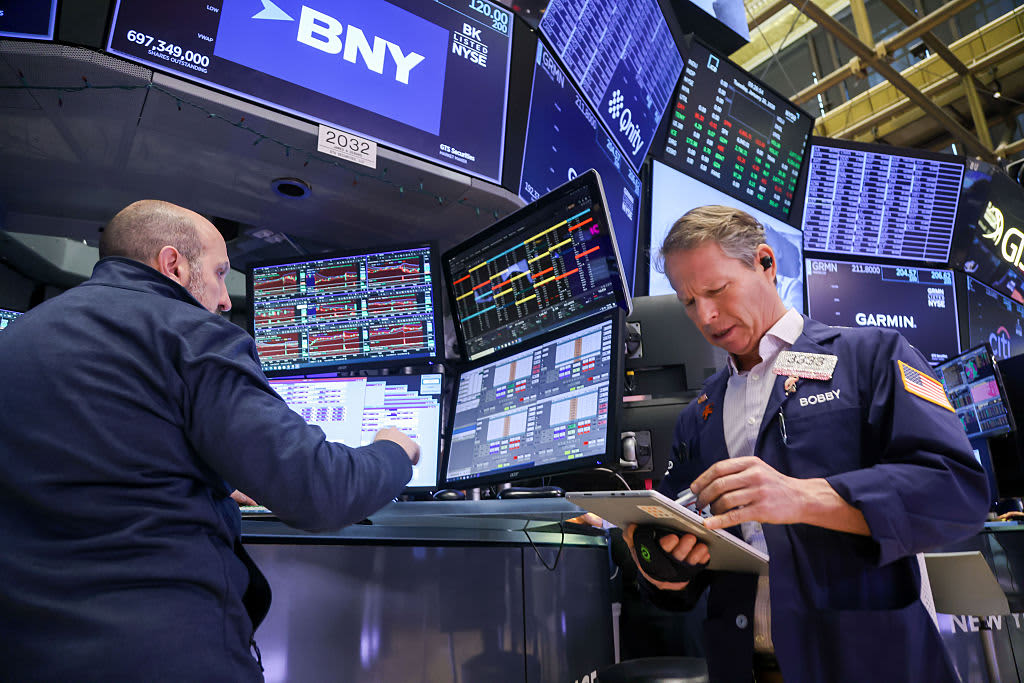
Traders work on the floor at the New York Stock Exchange, Jan. 20, 2026.
Michael Nagle | Bloomberg | Getty Images
Stocks rose after President Donald Trump told the World Economic Forum he would not use force to acquire Greenland, easing a concern that has rattled markets and caused a flight from dollar-based assets.
Trump was commenting in his Davos, Switzerland speech about how he believed the U.S. was carrying the financial and military load for NATO. Here’s what he said which boosted equities:
“We never asked for anything, and we never got anything. We probably won’t get anything unless I decide to use excessive strength and force, where we would be, frankly, unstoppable. But I won’t do that. Okay? Now everyone’s saying, Oh, good. That’s probably the biggest statement I made, because people thought I would use force. I don’t have to use force. I don’t want to use force. I won’t use force.”
The 10-year Treasury price turned higher and the yield turned lower following Trump’s comments. The U.S. Dollar index pared its decline with other currencies.
While Trump ruled out military action, he did say Wednesday he was “seeking immediate negotiations to once again discuss the acquisition of Greenland by the United States.”
Stocks posted sharp losses in Tuesday’s session as Trump escalated his Greenland tariff threats and failed to rule out military use to take the territory controlled by Denmark. The 30-stock Dow slipped more than 870 points, or about 1.8%, while the S&P 500 lost roughly 2.1%. A drawdown in technology stocks led the sell-off, with the Nasdaq Composite sliding 2.4% on the day.
All three benchmark indexes logged their worst daily performances since Oct. 10. The sell-off also dragged the S&P 500 and the Nasdaq into negative territory for 2026.
The so-called sell America trade on Tuesday was accompanied by a spike in U.S. Treasury yields and a decline in the U.S. dollar. The 10-year Treasury yield surged and briefly topped 4.3% at the high of the day.
“America First is quietly driving diversification away from dollar assets, especially among government entities,” wrote Joyce Chang, chair of global research at JPMorgan in a note. “While we have long argued that the dollar maintains its transactional FX dominance, ‘Sell America’ narratives of diversification away from dollar assets have reemerged quietly but persistently.”
Treasury Secretary Scott Bessent told reporters in Davos Wednesday that the Trump administration was “not concerned” about the previous day’s sell-off.
Speaking in Davos on Tuesday, European Commission President Ursula Von der Leyen called Trump’s new tariff proposals a “mistake” that would plunge Europe and the U.S. into “a dangerous downward spiral.”
“Our response will be unflinching, united and proportional,” she said, adding that the EU stood in “full solidarity” with Greenland and Denmark.
Bernd Lange, who chairs the European Parliament’s international trade committee, will hold a press conference in Strasbourg, France, later on Wednesday. The BBC, citing unnamed sources, reported that he will announce a suspension of the U.S.-Europe trade deal finalized over the summer.
Also speaking at the WEF on Tuesday, French President Emmanuel Macron said a potential response to new U.S. tariffs was to use the EU’s Anti-Coercion Instrument, which would restrict U.S. businesses’ access to Europe’s single market. Triggering the ACI could exclude American suppliers from participation in EU public tenders, place export and import restrictions on goods and services and put limits on foreign direct investment.
Source – Middle east monitor