U.S. begins blockade in Strait of Hormuz; Trump warns Iran ‘attack ships’ to stay away

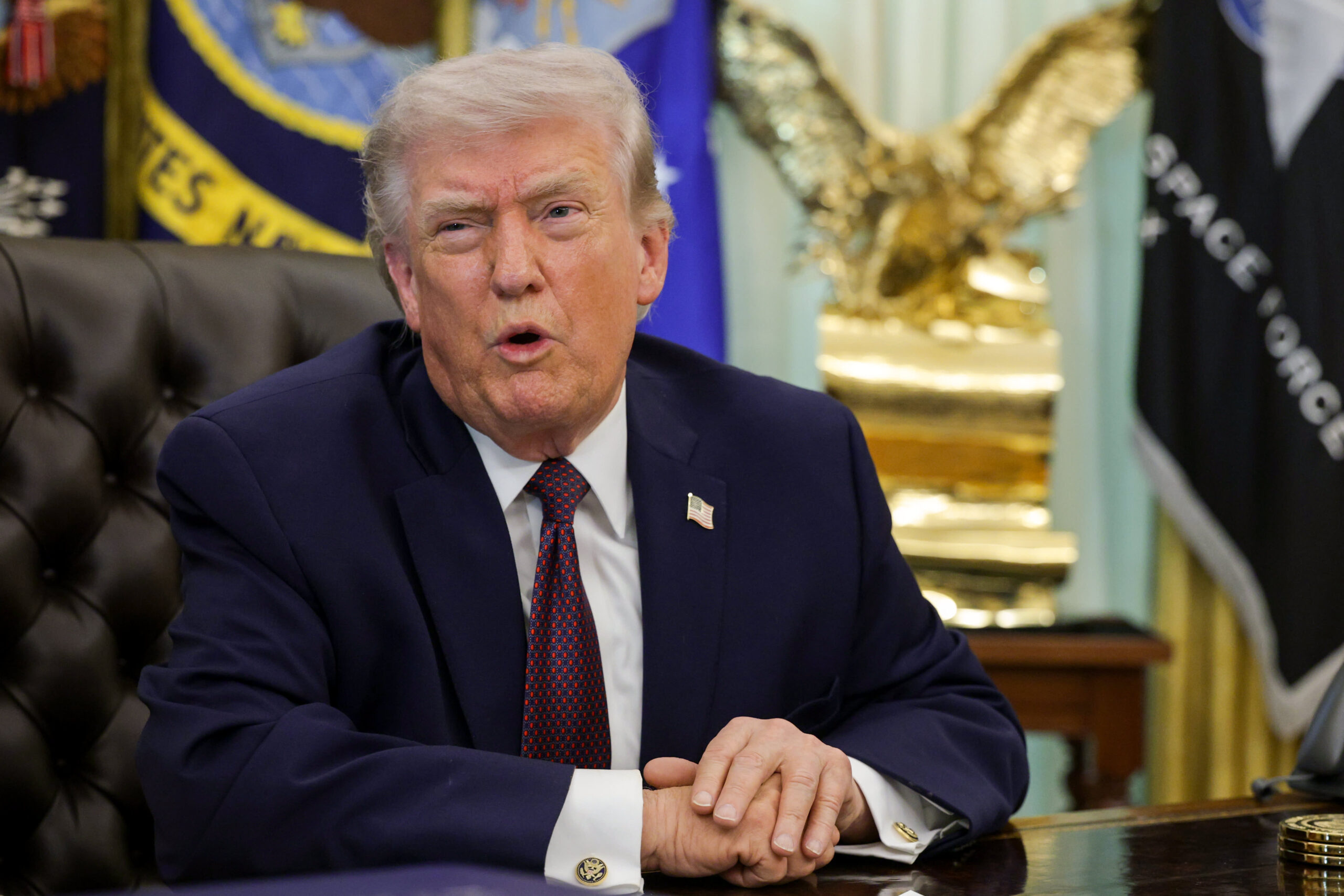
U.S. President Donald Trump answers questions after signing an executive order to limit mail-in voting in the Oval Office of the White House on March 31, 2026 in Washington, DC.
Alex Wong | Getty Images
The U.S. on Monday said it began blocking ships from entering or exiting Iranian ports in the Strait of Hormuz, attempting to ratchet up pressure on Iran to reopen the key oil route after peace negotiations collapsed.
“We can’t let a country blackmail or extort the world, because that’s what they’re doing,” President Donald Trump told reporters outside the Oval Office after the blockade took effect at 10 a.m. ET.
Asked if the goal of the obstruction is to force Iran to reopen the strait or come to the negotiating table, Trump said, “Both of those things, certainly, and more.”
Trump’s impromptu remarks at the White House came after Vice President JD Vance returned from Pakistan without a deal with Iran and with last week’s two-week ceasefire looking shakier amid heightened tensions in the Middle East.
Trump on Monday claimed Iran wants to make a peace deal “very badly,” despite negotiations in Pakistan over the weekend ending in a stalemate.
The sticking point was “over the fact that they will never have a nuclear weapon,” Trump said of Iran.
“We agreed to a lot of things, but they didn’t agree to that, and I think they will agree to it. I’m almost sure of it. In fact, I am sure of it. If they don’t agree, there’s no deal,” he said.
As the blockade took effect Monday morning, Trump earlier Monday warned Iran’s “fast attack ships” not to come near the U.S. forces enforcing the closure.
“If any of these ships come anywhere close to our BLOCKADE, they will be immediately ELIMINATED, using the same system of kill that we use against the drug dealers on boats at Sea,” Trump wrote on Truth Social. “It is quick and brutal.”
A White House official confirmed to CNBC that the blockade has taken effect.
Trump had announced the blockade plan Sunday in a social media post accusing Tehran of “WORLD EXTORTION” by continuing to throttle traffic through the strait.
The U.S. blockade applies to “any and all Ships trying to enter, or leave, the Strait of Hormuz,” Trump said.
The U.S. Central Command later added the caveat that American forces “will not impede freedom of navigation for vessels transiting the Strait of Hormuz to and from non-Iranian ports.”
“The blockade will be enforced impartially against vessels of all nations entering or departing Iranian ports and coastal areas, including all Iranian ports on the Arabian Gulf and Gulf of Oman,” CENTCOM specified.
Trump said in his Truth Social post that other countries will “be involved” with the blockade. But some U.S. allies, including NATO members Britain and France, have already refused to join the effort.
Iranian officials have responded defiantly, warning the U.S. blockade will only drive global energy prices higher.
“Enjoy the current pump figures. With the so-called ‘blockade’, Soon you’ll be nostalgic for $4–$5 gas,” Iran’s parliamentary speaker, Mohammad Bagher Ghalibaf, said in an X post Sunday.
A fragile U.S.-Iran ceasefire, while not officially scrapped, has been deeply frayed as each side has accused the other of violating the conditions of the truce.
The ceasefire was brokered last week, after Trump issued an ultimatum declaring Iran’s “whole civilization will die” if no deal was reached by Tuesday evening.
Vance and other U.S. negotiators flew to Islamabad for weekend peace talks with Iran, raising hopes that a deal to end the war was at hand.
But Vance said early Sunday that the U.S. delegation would return home without a deal. After 21 hours of of negotiations, Iran still refused to agree not to seek or develop a nuclear weapon, Vance said.
This is developing news. Please check back for updates.
Source – Middle east monitor