Tech outages are fueling a new doomsday economy
Jason Reginato | CNBC
Americans are shopping like there’s no tomorrow.
A spate of high-profile technology outages that grounded planes, halted email access and slowed bank transactions have left many people worried about artificial intelligence-driven cyberattacks and the state of the U.S. energy grid.
Government officials have dismissed rumors and speculation circulating online that there could be a nefarious culprit for the series of malfunctions. Despite those assurances, consumers like Sabrina Cepeda are readying for a larger-scale technology blackout or other emergency event.
In recent days, the Houston resident has purchased propane and lighter fluid for cooking and heating equipment that can be used without electricity. The mother of three also replenished her backup stockpiles of non-perishable foods, hygiene products and allergy medicine in the event that her family is homebound for several days.
“I have a way to keep my family fed, clean, hydrated, warm and safe,” said Cepeda, 39. “You want to have these things and not need them, rather than need them and not have them.”
The doomsday economy is catching a bid. Wall Street and retailers are taking note.
Emergency prep buying
At least half a dozen major technology outages took place in the U.S. between Nov. 12 and Nov. 17. In that time frame, spending at brands specializing in emergency products spiked about 400% compared with the same period a year prior, according to card data analyzed exclusively for CNBC by Consumer Edge.
At Ready America, which sells products like emergency survival kits, prepackaged water and high-calorie food bars, sales through e-commerce platforms have seen a roughly five-fold increase in recent days. In addition, corporate customers who keep the Vista, California-based company’s supplies in their offices in case of emergency have called in to order more.
A worker at The Surplus Store moves cases of emergency water for a customer, Nov. 18, 2026 in Los Angeles, California.
Justin Sullivan | Getty Images
The company has rarely seen this much demand since the Covid pandemic sent Americans into lockdown more than six years ago, said Ready America President Trevyn Reese. As a result, Ready America asked its suppliers to scale up production. The family-owned business has faced a shortage of water purification tablets, and redirected shoppers to alternative offerings like prepackaged water pouches.
“With everything going on in the news right now, we’ve seen a large spike of people wanting to get prepared,” said Reese.
While the string of outages brought power-related concerns to a boiling point, data shows that worries had been bubbling under the surface for weeks.
Shoppers began significantly ramping up buying from emergency preparedness brands late last month, according to Consumer Edge. Around that time, Fox News reported that the Pentagon was preparing U.S. military bases to operate for at least 90 days without external support. Exacerbating those fears was the ongoing war with Iran that President Donald Trump signaled could ramp back up.
A man leaves with a power generator, water and other supplies after shopping at a Home Depot after Hurricane Ian caused widespread destruction in Cape Coral, Florida, September 30, 2022.
Marco Bello | Reuters
Firearm trade group NSSF said that gun sales rose about 8% in October from the same month a year prior. Retailers and gun manufacturers have anecdotally reported that demand has remained elevated into November, which NSSF said can be attributed to a combination of uncertainty tied to the midterm election and the recent outages.
“If people are investing in firearms and ammunition, they’re telling you very directly, with their wallet, what their priority is,” said Mark Oliva, NSSF’s managing director of public affairs. “You’re literally investing in a product that’s going to be able to protect your life and protect the lives of your family.”
‘Apocalyptic concerns’
Now, the doomsday talk has begun making its way to Wall Street.
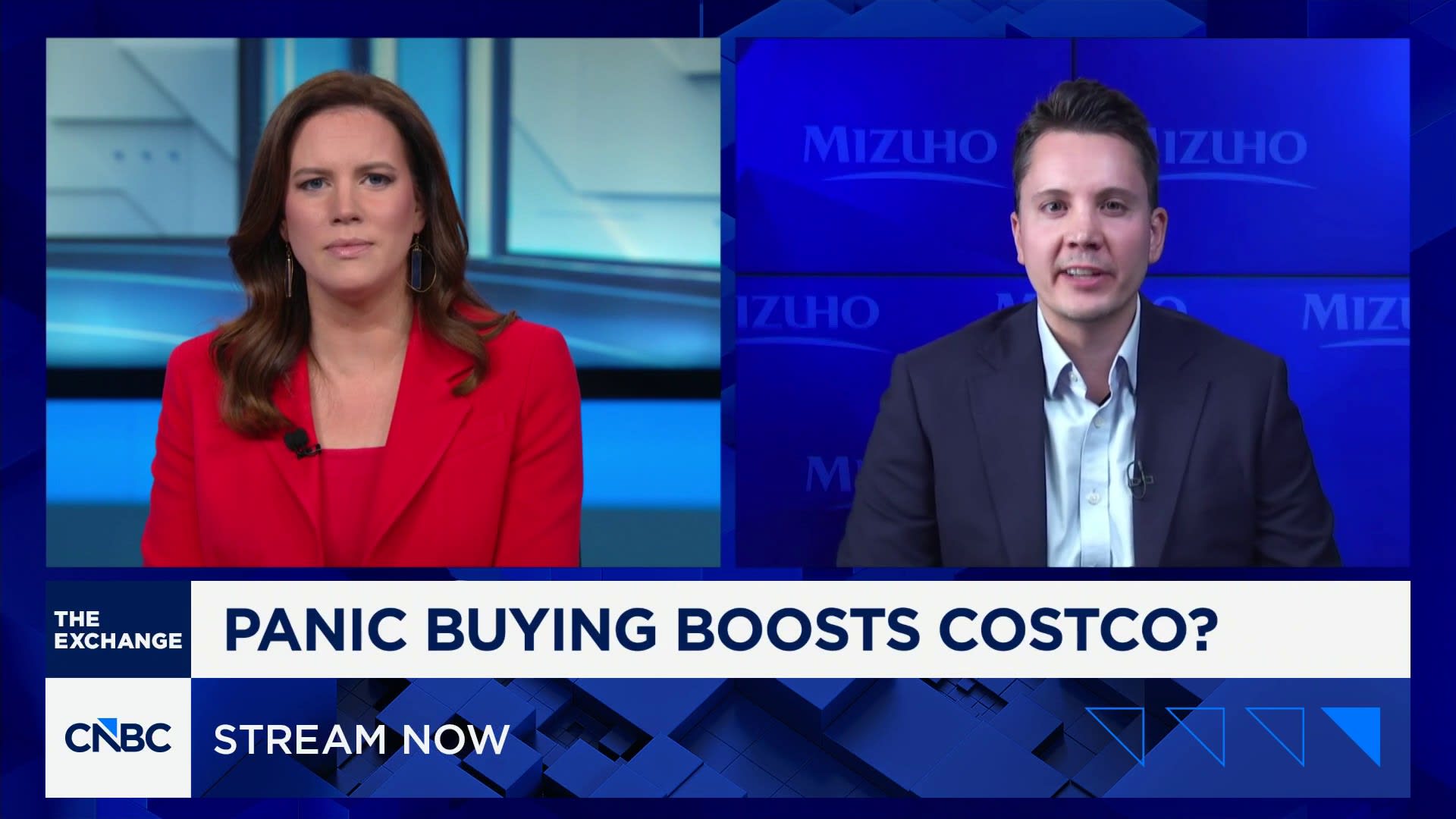
Mizuho told clients on Monday that consumer worries about the outages — coupled with what the bank called “apocalyptic concerns” swirling on social media — drove shoppers to stock up on emergency supplies at Costco. As a result, Mizuho said it expects a key measure of non-fuel sales growth for Costco in November to rise above 10% for the first time since 2022.

And RBC said so-called doomsday prepping has had a “real impact” on buying behavior around the globe over recent weeks. Still, the Canadian bank reported that the trend has so far boosted sales for only a small basket of items, such as shelf-stable proteins, water purification products and dry-pantry foods.
Clients of Richard McWhorter, a private wealth advisor at SRM, have been rushing to Costco to buy goods in bulk and splurging for power generators. McWhorter said he’s also fielded questions about how to prepare for a situation in which the financial system goes down.
“I’ve never seen anything like this in my life,” McWhorter said. “There’s the financial side of what I do, and then there’s the psychological side. And the past two weeks have been much more psychological.”
Metal dealer American Hartford Gold reported an uptick in customer inquiries this week. Company president Max Baecker said he heard from some customers that their interest in products like gold — long considered a safe-haven asset during times of turmoil — was driven by newfound concern about being overly reliant on digital financial networks following a glitch at JPMorgan Chase that affected customer transactions for several hours.
Vice President JD Vance abruptly canceled his appearance at a New York Times summit on Wednesday to attend meetings about the technology outages. A day prior, Jay Clayton, the U.S. director of national intelligence, told CNBC that the recent outages were not a cyberattack or a coordinated effort by a foreign nation.
Still, Sen. Mark Warner, D-Va., told CNBC on Wednesday that people were “freaked out” by the outages. Warner, who acts as the vice chairman of the Senate Intelligence Committee, said that the U.S. was “lucky” to have not yet seen a major AI-generated cyberattack or crisis due to AI agents going rogue.
Investors may begin pushing companies to accelerate their cybersecurity spending out of an abundance of caution around rogue AI agents following the outages, according to Macro Hive CEO Bilal Hafeez. Such a situation would be reminiscent of the antivirus software push seen during the dot-com boom, he said.
The Global X Cybersecurity ETF (BUG) has climbed around 3% over the past two weeks, bucking the downtrend seen among AI stocks and the broader technology trade. The Nasdaq Composite on Friday fell into negative territory for 2026, putting the tech-heavy index on track for its first losing year since 2022.

The BUG ETF and Nasdaq Composite, 5-day
The ‘old-fashioned way’
To be sure, not everyone on social media has bought into the idea that they should be prepping for a doomsday scenario. In satirical videos posted on TikTok, users joked that they were gearing up by placing orders in the Starbucks drive-thru or purchasing significant quantities of alcohol.
Still, the topic appears to be on the minds of a growing number of Americans. U.S. Google searches for the term “prepping” have more than doubled when comparing the past month with the same period a year prior. On YouTube, queries for videos about “survivalism,” a term describing the practice of preparing for emergencies, have soared by more than 5,000% over the same time frame.
Cepeda, the Houston mom, sees emergency prep efforts as a way to be safe rather than sorry. She’s previously tapped into backup food stashes during extreme weather events like Hurricane Harvey in 2017 and Winter Storm Uri in 2021.
But this year is the first time that she’s felt she needed to be prepared for a potential emergency caused by technology outages, she said. Cepeda and her husband have ensured they have enough cash on hand and fuel in their cars if there’s a broader hit to the U.S. power grid, she said.
“We rely so much on technology,” Cepeda said. “You need to be able to do these things the more traditional, old-fashioned way.”
Source – Middle east monitor