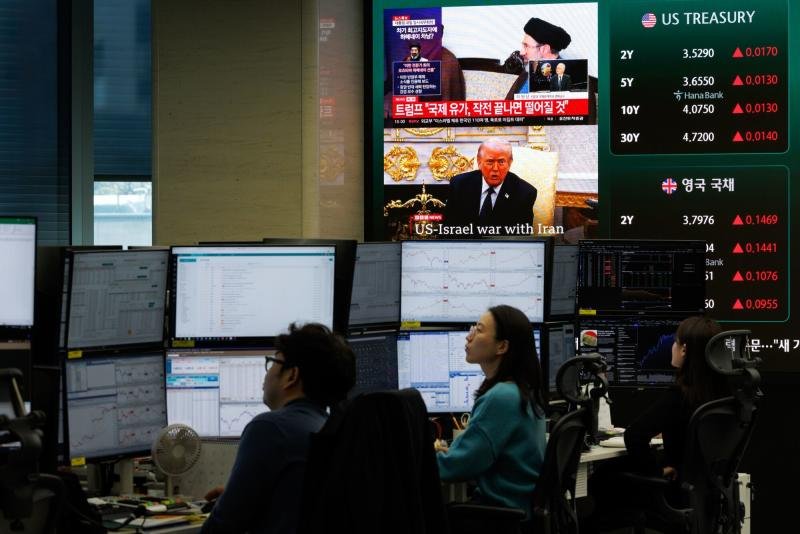
Iran war punctures strategy of ‘Sell America, Buy Asia’
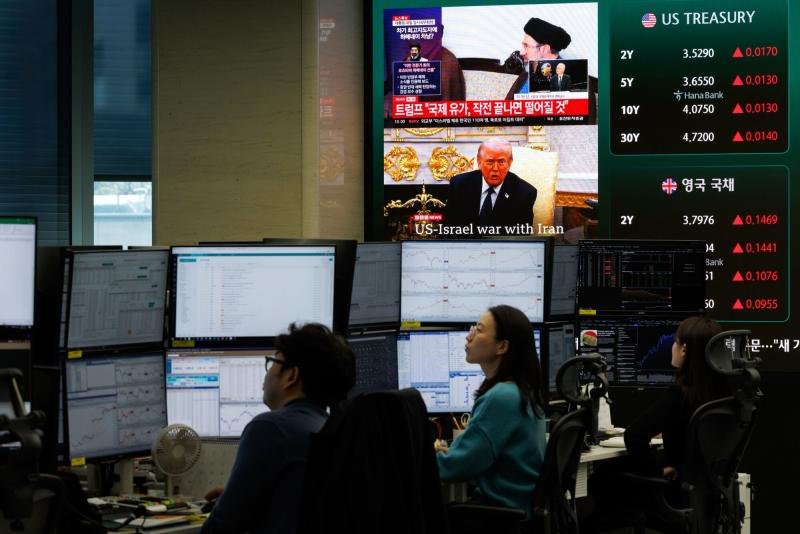
HONG KONG — The war in Iran is forcing investors to reevaluate one of their most profitable stock strategies, leading some to conclude that the “Sell America, Buy Asia” trade has reached an inflection point.
Despite a rebound Thursday, the MSCI Asia Pacific Index has tumbled about 6% this week, compared with a 0.1% slide in the S&P 500. The swing indicates a reversal of a rotation by global funds into Asia and a renewed shift toward the United States as a haven, a move also supported by a stronger US dollar. Futures on the US benchmark are down less than 0.1% at 6.41am in New York on Thursday morning.
The Iran war has impacted Asian stocks disproportionately, partly because of the region’s outsize reliance on fuel shipments through the Strait of Hormuz. There’s also growing concern that a sustained supply shock may trigger a global economic slowdown, undermining key export industries. As a result, investors are taking profits from the recent AI-driven rally, particularly in the outperformers in the past year: South Korea and Taiwan.
“Capital doesn’t wait for certainty — it’s already rotating, and the dollar’s strength this week tells you everything about where the smart money is heading,” said Hebe Chen, senior market analyst at Vantage Global Prime. “China, Japan, Korea and Taiwan are pure import dependents with no buffer, making this oil shock exponentially more corrosive for the region than for the West.”
Asian equities had been favoured for their artificial intelligence (AI) hardware exposure, relatively cheap valuations and solid earnings growth.
Oil exposure
The surge in Brent crude is now stoking fears of inflation, threatening to turn some of the region’s strengths into vulnerabilities. Even as stocks rebounded, the underlying dynamics remained: oil extended its rally for a fifth straight day even after US President Donald Trump expressed confidence in the military campaign.
“For the AI capex story, stagflationary pressure is the ultimate kill switch — when the cost of capital rises and growth visibility collapses simultaneously, the region’s most ambitious infrastructure bets become the hardest to defend in any boardroom,” according to Vantage’s Chen.
Asian economies including China, India and Indonesia are among the world’s biggest oil importers, according to Bloomberg Economics. Goldman Sachs estimates that a 20% rise in the price of Brent crude would cut regional earnings by 2%.
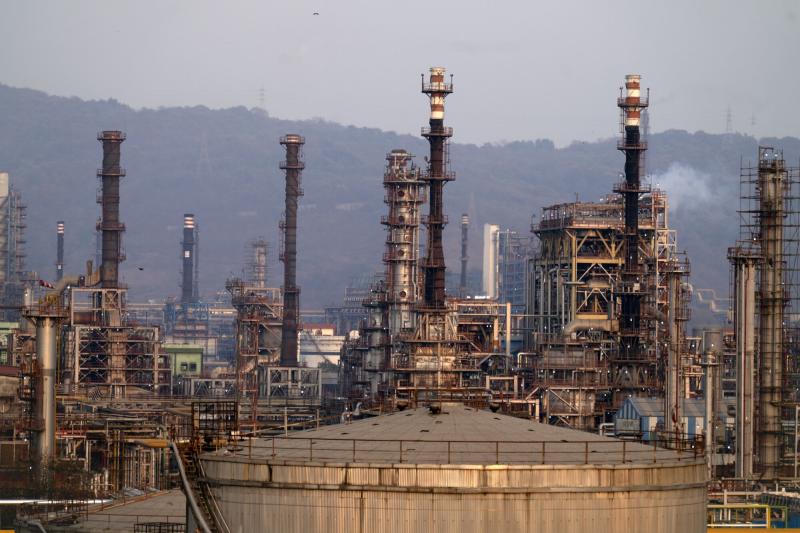
A Bharat Petroleum Corp oil refinery in Mumbai, India, on Tuesday. (Photo: Bloomberg)
Japan and South Korea are particularly exposed to disrupted shipping routes, in contrast to China, which has larger reserves and access to Russian crude. Highlighting supply concerns, Beijing has told the country’s largest oil refiners to suspend exports of diesel and gasoline.
“Japan and South Korea could face more pressure as over 60% of their oil imports are transported via the Strait of Hormuz,” said Alicia Garcia-Herrero, chief economist for Asia Pacific for Natixis SA, adding that the economic impact on Asia goes beyond oil, with consequences for mobility, construction, finance and defence.
A sustained rise in oil prices could fundamentally alter the equity outlook by tightening financial conditions and weakening external balances across Asia. By comparison, the US is relatively insulated, benefiting from its status as an energy exporter and from safe-haven inflows, according to Amundi Investment Institute. DWS also sees more impact in Europe and Asia, given US fuel production.
“The Strait of Hormuz is key here and the United States does not depend on its oil needs from the Middle East, not very much,” Ajay Rajadhyaksha, global chairman of research at Barclays said in a Bloomberg TV interview with Haslinda Amin Wednesday. “It’s far more important for Europe, but most important for the big Asian economies, for China, South Korea and Japan.”
Investors are also revisiting the 2022 playbook, as recent market reaction echoed the aftermath of Russia’s invasion of Ukraine, including a strengthening dollar. A firmer greenback pressures local currencies, limits central banks’ room to ease policy and darkens the outlook for corporate earnings.
A Bloomberg gauge of the US dollar has strengthened 1.3% so far this week, headed for its biggest weekly gain since November 2024. Meanwhile, a similar gauge for Asia’s currencies has weakened 0.9%. Traders are now pricing in about 50 basis points of tightening for the Bank of Korea over the next 12 months, up from about 25 basis points expected at the end of last month, according to data compiled by Bloomberg.
“The lack of support from monetary easing will be negative for stocks,” said Rajeev de Mello, global macro portfolio manager at Gama Asset Management. “Sentiment was very buoyant among EM investors and that may unwind as well.”
Momentum unwind
To be sure, Thursday’s rebound shows how quickly sentiment can shift, and many investors remain optimistic about Asian stocks’ longer-term outlook. UBS Global Wealth Management upgraded South Korean equities, citing the historic 20% correction and recent volatility reflected technical unwinds rather than a deterioration in fundamentals.
“Barring some further escalation in the Middle East, which for the moment seems unlikely given the depletion of Iranian capabilities by joint US and Israeli strikes, we would expect Asian markets to continue their positive trajectory,” said Jon Withaar, a portfolio manager at Pictet Asset Management in Singapore. He sees Japan’s Takaichi-trade, South Korea’s corporate governance reforms and the global memory chip crunch as key catalysts for further gains.

Israeli military vehicles on a road on the Israeli side of the Israel-Lebanon border, amid an escalation between Iran-backed Hezbollah and Israel, and amid the US-Israeli conflict with Iran, in northern Israel on Thursday. (Photo: Reuters)
But even without the broader macroeconomic threat, Asian stocks were vulnerable in a broad de-risking move, given their recent rare outperformance against US peers. Foreign investors sold $6.3 billion of Taiwanese stocks in the first three days of the week, putting the market on track for its second-largest weekly net outflow on record, according to data compiled by Bloomberg.
In 2025, the MSCI Asia Pacific Index beat the S&P 500 by the most since 2017. Despite the recent pullback, it still leads the US by 7 percentage points this year — leaving room for further unwinding of crowded positions.
“The current selloff in Asia is driven by a confluence of events, not just geopolitical risks,” said Elfreda Jonker, client portfolio manager at Alphinity Investment Management. “Some Asian markets like South Korea are particularly vulnerable at the moment given the recent strong rally and resultant high multiples.”
Source – Bangkok News