Trump administration offers shifting narrative for U.S. war in Iran as Democrats pounce

President Donald Trump says combat will continue in Iran until U.S. “objectives” are complete. Those objectives and the justification for the war have remained fluid more than 48 hours into the conflict.
Trump and his proxies have not been aligned on their narrative, leading to confusion about how Trump and his advisors are defining the endgame for the escalating conflict.
Trump began a military buildup near Iran after promising dissidents “help is on its way” when protests against its government rocked the country in January. The stated justification since the attack began Saturday has whipsawed among preventing Iran from obtaining a nuclear weapon, deposing the Iranian regime that brutally represses dissent, stopping an imminent attack from Iran on U.S. interests and following Israel’s lead.
The muddied messaging underscores a broader question of whether Trump is pursuing solely a military objective or full-blown regime change.
The changing justification and growing list of objectives raise questions about the administration’s motives and the extent to which the U.S. will be entangled in Iran, a more urgent question as the death toll for U.S. service members has climbed to six. The dynamic has incensed Democrats, who have largely come out against the war, and led a handful of Republicans to raise questions.
“We have seen the goals for this operation change now, I believe, four or five times,” Sen. Mark Warner, D-Va., the top Democrat on the Senate Intelligence Committee, told reporters Monday after meeting with Secretary of State Marco Rubio. “It was about the Iranian nuclear capacity, a few days later it was about taking out the ballistic missiles, it was then — in the president’s own words — about regime change … and now we hear it’s about sinking the Iranian fleet.
“I’m not sure which of those goals, if met, means that we’re at an endgame,” Warner said.
Sen. Richard Blumenthal, D-Conn., was more blunt in his assessment.
“The president’s been all over the place,” he said.
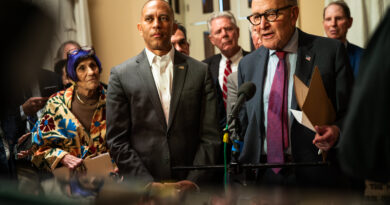
Sen. Mark Warner, D-Va., speaks to the media following a briefing for congressional leaders on the situation in Iran, on Capitol Hill in Washington, March 2, 2026.
Ken Cedeno | Reuters
Trump said in a video message when the invasion began on Saturday that his objective was to “defend the American people by eliminating imminent threats from the Iranian regime, a vicious group of very hard, terrible people.”
The president said the U.S. military would raze the country’s missile silos, prevent it from ever obtaining a nuclear weapon, destroy its terrorist proxy network and sink its navy. He also urged the Iranian people to topple the leadership that has ruled the country since 1979 — an explicit call for regime change that raised eyebrows even among some of his allies.
After the killing of Iranian leader Ayatollah Ali Khamenei was confirmed, unnamed U.S. officials briefed the media on the operation Saturday after Trump’s Truth Social video. They said something different: That the U.S. launched a preemptive strike to stave off the imminent threat of an Iranian offensive.
Then on Sunday, Trump spoke with myriad media outlets, including CNBC. He told The Atlantic that Iran waited too long in negotiations over its nuclear program and could have struck a deal and told CNBC that the U.S. attacks were “ahead of schedule” without saying what schedule. He later told the Daily Mail the war could grind on for more than four weeks.
Later Sunday, Trump said in a second video address that combat would continue “until all of our objectives are achieved, and we have very strong objectives.” He said he was doing it to ensure security “for our children and their children,” while reiterating his call for regime change. He warned more U.S. casualties were likely.
On Monday, Trump again reiterated his priorities as destroying Iran’s missile capabilities, destroying its navy, preventing the country from getting a nuclear weapon and destroying Iran’s ability to fund terrorist proxies.
Cabinet secretaries offer different objectives
Then there’s Trump’s top aides — some of whom are potential contenders for president in 2028.
Defense Secretary Pete Hegseth told reporters Monday the war is “not a so-called regime change war,” saying the effort is to stop Iran from building a “conventional shield” for its nuclear program.
Rubio then offered a different characterization Monday, arguing, as the administration did on Saturday, that the mission was in part a preemptive strike. But Rubio appeared to suggest the attack from Iran would come only after an attack on Iran by U.S. ally Israel.
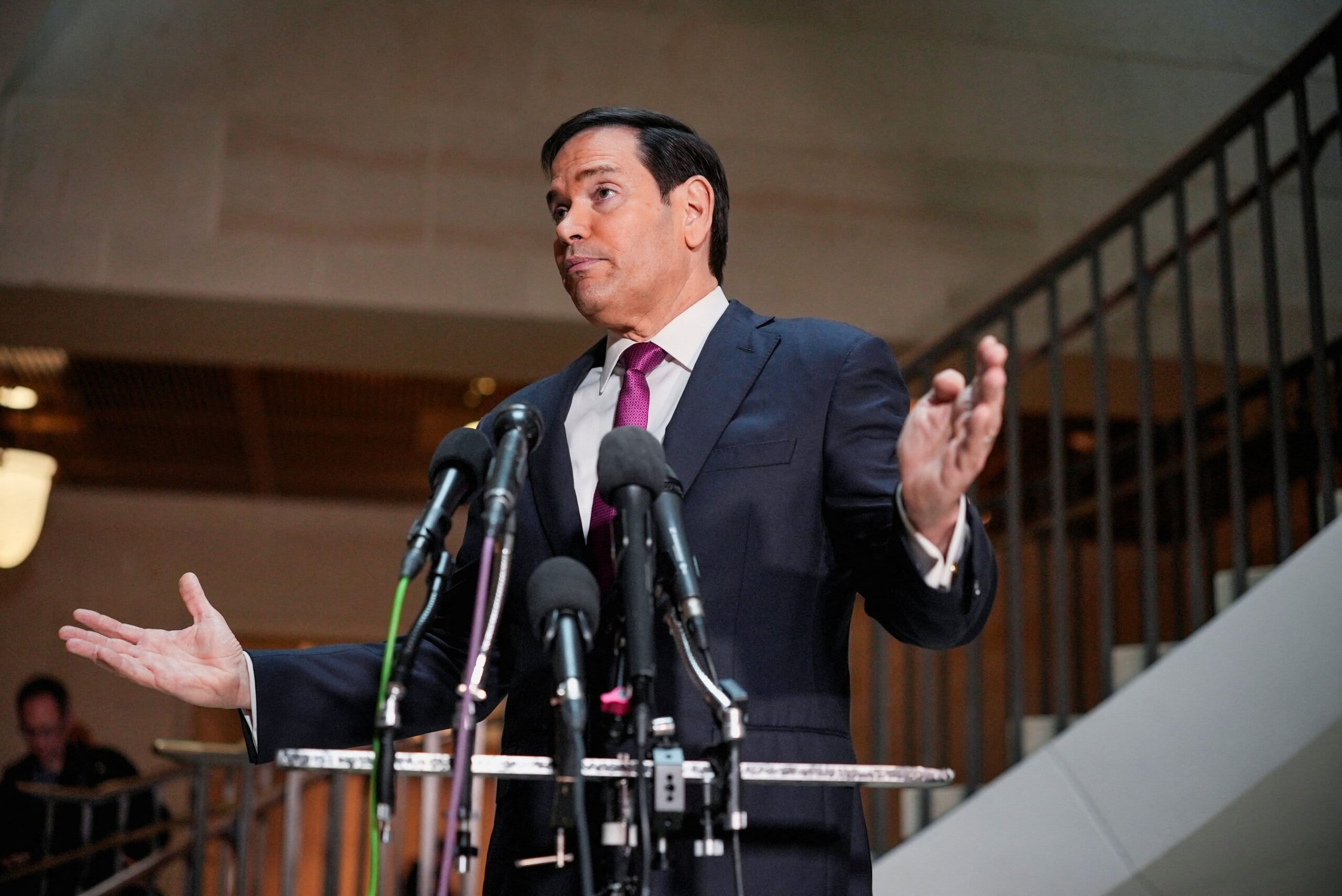
Secretary of State Marco Rubio arrives to brief House and Senate leaders on U.S. military action in Iran, at the Capitol in Washington, March 2, 2026.
Brendan Smialowski | AFP | Getty Images
“We knew that there was going to be an Israeli action, we knew that would precipitate an attack against American forces and we knew that if we didn’t preemptively go after them before they launched those attacks, we would suffer higher casualties,” Rubio told reporters before briefing key members of Congress. “We were not going to sit there and absorb a blow before we responded.”‘
Trump disputed that Tuesday, saying during a meeting with German Chancellor Friedrich Merz, “No, I might’ve forced their hand” in reference to Israel.
Rubio also doubled down on the “purpose of this” being to “destroy that missile capability.” Rubio echoed Trump, who earlier said Iran was trying to build more missiles to shield its quest to create a nuclear weapon.
“This had to happen no matter what,” Rubio said.
And Vice President JD Vance, who himself has burnished a brand on avoiding another extended conflict in the Middle East, on Monday insisted the war would not drag on and said of Trump “he is not going to rest until he accomplishes that all-important objective of ensuring that Iran can’t have a nuclear weapon.”
Analyst sees multiple objectives
Analysts say it’s possible the U.S. could be pursuing both regime change and a functional disarmament of Iran — a long-term goal of U.S. administrations over decades. They’re looking at what targets the U.S. and Israel are both striking to determine motives. There is also a possibility the U.S. and Israel are pursing both objectives separately.
“When you just look at things being struck, I would say yes, they’re going after both,” said Mark Cancian, a retired Marine Corps colonel who is a senior advisor with the Center for Strategic and International Studies. “But also, there’s a question about who’s going after what … so it could be that we’re just going after different goals, [Israel is] going for regime change, and we’re going for nuclear programs, missile programs, terror.”
Cancian said such a scenario could muddle the war’s endgame.
“Day to day during the campaign, it might not make a big difference, but where it may make a big difference is when you end,” Cancian said. “I could imagine a situation where the Iranian government accepts [the U.S.] conditions, that’s what happened in Venezuela. But I could also imagine a situation where the Israelis just kept bombing.”
“At some point, they’re going to have to make a decision; right now, they don’t have to face that question, but at some point they will need to face it … it would be particularly a pressing issue if the Iranian government offers peace,” he said.
— CNBC’s Justin Papp contributed to this report.
Source – CNBC