Trump policies, China’s biotech boom are ending Europe’s pharma powerhouse era
Boxes of medication are seen on the shelves of the Keencare pharmacy, a member of the Green Light Group, on September 19, 2024 in London, England.
Leon Neal | Getty Images News | Getty Images
Once the go-to location for global drugmakers, Europe is now being squeezed by President Donald Trump’s aggressive trade and drug-pricing policies on one side, and China’s explosive biotech boom on the other.
The pharma industry is a cornerstone of Europe’s economy, but the continent’s declining competitiveness has companies looking elsewhere to place investments. And the issue isn’t just economic. New launches of critical medicines are at stake, as prices and regulations discourage companies from launching them on the continent.
Uncertainty in the U.S. and threat of most-favored-nation pricing “has given pharma companies a lever to pull the negotiations with European governments or European regulators,” ING healthcare analyst Diederik Stadig told CNBC, referring to a Trump policy where the price of a drug in the U.S. is set to the lowest price paid by another comparable country.
Meanwhile, China has emerged as a leader in biotech — the innovation engine of pharma. Global pharmaceutical companies are increasingly looking to the country for innovation and to potentially source their next blockbuster drug.
From leading to lagging
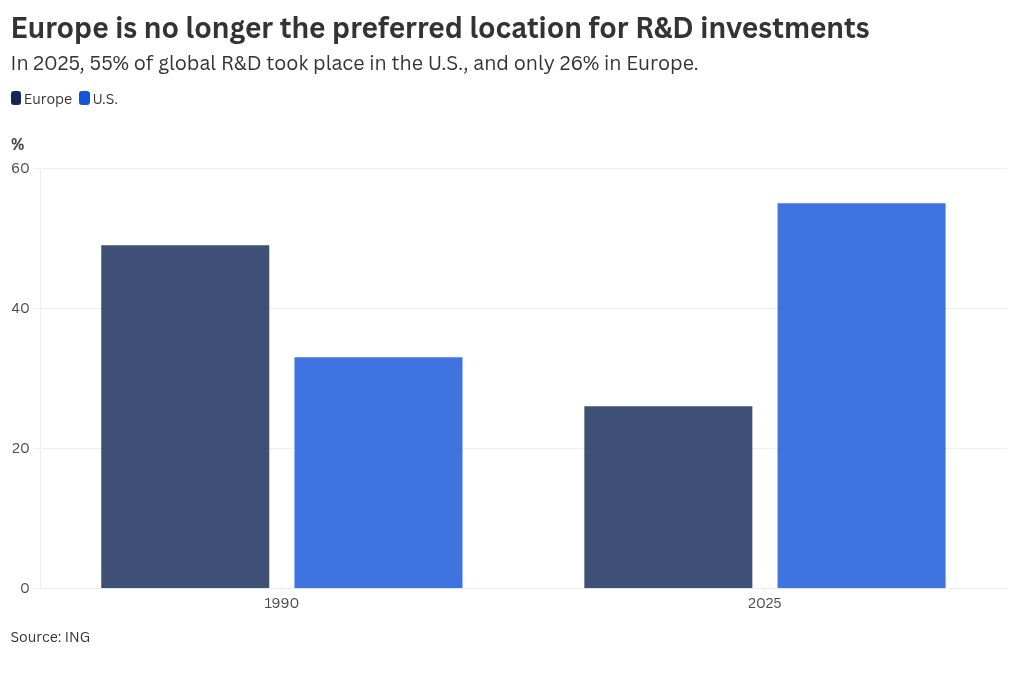
For decades, Europe was the world’s undisputed laboratory. In 1990, nearly half of global research and development took place in Europe, and about a third in the U.S., according to research by ING. Today, the U.S. share of R&D has jumped to 55%, while Europe’s has plummeted to 26%.
For decades, companies have lamented Europe’s fragmented capital markets, single-market adoption on pricing and clinical trials, and uneven reimbursement policies.
U.S. tariffs and most favored nation drug pricing have “injected urgency into the debate in a way we haven’t really seen before,” said Stadig.
Washington is increasingly viewing biotech and supply chains as a national security issue, emphasizing the importance of medicine supply chains remaining on American soil.
Meanwhile, China has evolved into an innovation leader, scoring major deals with global pharma companies to access the country’s early-stage science.
Ten years ago, Chinese-developed molecules accounted for just 4% of the global pipeline. Today, they represent nearly a third, according to ING.
“Continued licensing, targeted fundraises, and differentiated science suggest China’s biopharma advantage will likely persist despite rising geopolitical friction,” a January PitchBook report found.
A paper published earlier this year by researchers at Bocconi University found that the U.S. “is consistently more successful than the EU in attracting and retaining R&D activity within its territory, while China emerges as the largest net recipient of foreign R&D worldwide.”
Aggressive U.S. policies
Last week, the U.S. imposed new tariffs on branded drugs of up to 100%. They would only, however, apply to drugmakers that have not yet struck deals with the president to lower drug prices for Americans, meaning it will have a limited impact on many companies.
Nevertheless, the tariffs mark “another push for Europe to finally get its act together on competitiveness,” and add to a growing number of external pressure points exposing Europe’s structural weakness, said Stadig.
The U.S. also continues to be the most important market for pharma companies, and there’s a significant incentive for companies to produce there because higher medicine prices make it so profitable.
A frequently cited study by the RAND Corporation in 2024 found that drug prices in the U.S. were almost three times higher than in 33 other high-income countries.
But most-favored-nation pricing threatens pharma companies’ U.S. profit margins. They must now decide whether to delay launches in Europe to avoid having to offer the drug at lower prices to American consumers, or adopt a single global price for a drug, even if that is too high for some markets.
“Every company that I’ve worked with, there’s a lot of thought being put into [those options],” McKinsey Senior Partner Greg Graves told CNBC in February.
Already, some drugs that are launched in the U.S. don’t make it to Europe because prices are much lower, an issue that could get even worse under most-favored-nation pricing.
Depending on the class of drugs, it means companies will start making decisions based on whether to pursue high volumes or high value.
“For drugs that value is the answer, we’ll see postponements in launches in Europe,” Stadig said. And if nothing changes, “we will see a gradual reallocation of investments away from Europe and towards the U.S.”
“We need to increase spending and eradicate government clawbacks and taxes – these policies are critical to keeping companies in the EU and improving access.”
Nathalie Moll
EFPIA Director General
The industry, experts, and companies largely agree that something needs to change.
Europe has the potential to lead in life sciences. Still, it will continue to lose out to other parts of the world unless it increases spending on new medicines, delivers faster access for European patients, and creates a better operating environment for innovator companies, according to the European Federation of Pharmaceutical Industries and Associations (EFPIA).
Europe spends around 1% of GDP on pharmaceuticals compared with 2% in the U.S. and 1.8% in China, with EU spending on medicines remaining largely flat for two decades, according to the trade association.
“We need to increase spending and eradicate government clawbacks and taxes – these policies are critical to keeping companies in the EU and improving access,” EFPIA Director General Nathalie Moll told CNBC via email.
“This is critical not just for patients who will benefit from faster and more equal access to medicines, but for Europe.”
Without pharma, Europe would be running a trade shortfall of 88 billion euros ($103 billion), instead of a 130 billion euros surplus, Moll said.
Beyond pricing
While the U.S. offers consolidated biotech hubs like Boston and the Bay Area where science meets funding, Europe remains a patchwork of 27 different regulatory environments, creating a stifling hurdle for the sector.
EU biotech firms receive between five and ten times less venture capital than their American counterparts, according to ING.
“The UK has been the canary in the coal mine,” Stadig noted, citing big pharma’s recent pullbacks from Britain despite its world-class institutions like Oxford and Cambridge.
Last year, AstraZeneca, Eli Lilly and Merck, known as MSD in Europe, paused or scrapped planned investments in the U.K., citing various issues in the life sciences environment.
In December, the U.K. government announced plans to increase spending on medicines by 25% to improve the operating environment for drugmakers in the country by raising the threshold used to determine the cost-effectiveness of drugs.
The government also said it would reduce the rebate paid by pharmaceutical companies to the state-run national health service to a maximum of 15% from 23% previously.
But “price is not a silver bullet… you also need to think about your ecosystem,” noted Stadig.
Signs of life
Despite grim data on the EU’s competitiveness, there are signs of life. The EU’s recently proposed Biotech Act aims to streamline regulations, fast-track clinical trials, and address the investment gap. Spain has emerged as a surprise success story, becoming an attractive hub for clinical research through targeted government support.
Last year, the bloc proposed the Critical Medicines Act in an attempt to improve the availability, supply and production of critical medicines against the backdrop of shortages during the Covid-19 pandemic and geopolitical issues.
Furthermore, U.S. budget cuts to the National Institutes of Health (NIH) and stricter visa rules could allow Europe to jump on emerging fields like mRNA research.
“I’m actually bullish on Europe,” Stadig said. The EU has diagnosed the problem and has prioritized speed at the European Medicines Agency, which has long been an issue compared with the U.S. Food and Drug Administration and could become a competitive advantage given recent cuts to the FDA.
“Things are happening at the European level,” said Stadig. “It’s the member states… the national governments that haven’t realized the urgency of this.”
“We’re shooting ourselves in the foot in terms of these internal barriers that our national regulation creates.”

Source – CNBC