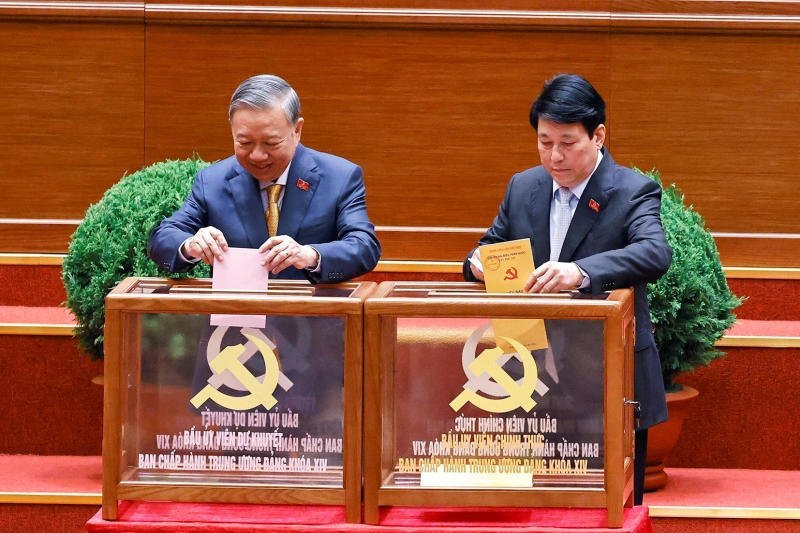
Investors cheer Vietnam reforms, To Lam re-appointment as Communist Party chief
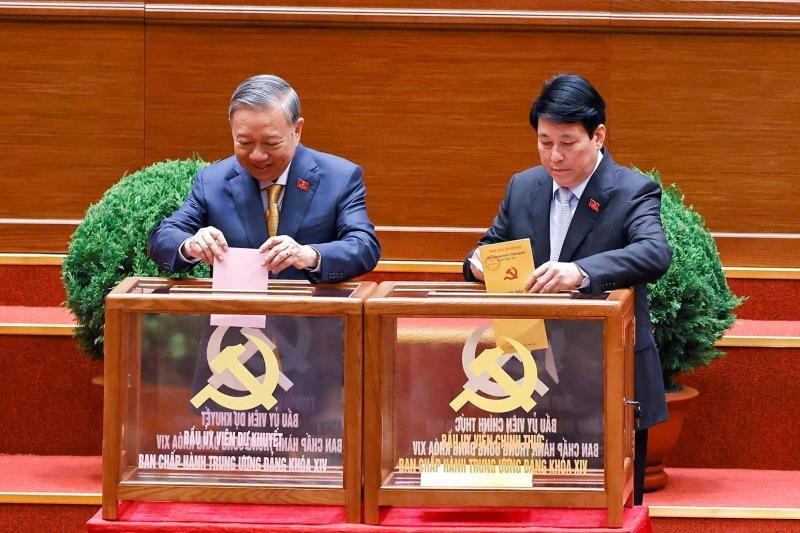
HANOI – Vietnam’s foreign and domestic investors have welcomed top leader To Lam’s economic reform drive, but his goal of double-digit growth under a model that has been called “market Leninism” looks unrealistic, economists and analysts say.
Vietnam’s Communist Party on Friday re-appointed To Lam as its general secretary for the next five years, according to an announcement made at its congress.
Reappointed Communist Party chief, Lam has led the Southeast Asian manufacturing hub to faster growth than its regional peers since he took office in mid-2024. Its stock market climbed nearly 40% last year, outpacing most other emerging markets, despite headwinds from US trade tariffs and frequent natural disasters.
To maintain the momentum, Lam has promised a “new growth model”, led by Vietnam’s conglomerates, that focuses on innovation and the digital economy, pivoting from the reliance on exports and cheap labour that have fuelled a decades-long economic boom by luring manufacturing investments from foreign multinationals such as Samsung, Apple and Nike.
Lam pledges 10% growth, World Bank tips 6.3% this year
While courting foreign capital and technology remains a priority, Lam says Vietnam must gradually move beyond cheap labour, pledging annual growth of at least 10% for the rest of this decade. Growth accelerated to 8% last year from 7% in 2024.
“Vietnam is on track to be the region’s outperformer in the next five years,” said Adam Samdin, an economist at Oxford Economics. But even if Lam’s reforms succeed, 10% growth may be too optimistic, he said.
That would require faster wage growth to spur consumption, potentially eroding Vietnam’s cost advantage with multinationals, he said.
The World Bank predicts Vietnam will keep growing faster than its regional peers but forecasts a slowdown to 6.3% growth this year and 6.7% in 2027, weighed by a delayed impact from President Donald Trump’s tariffs.
Vietnam’s government did not immediately respond to a request for comment on Lam’s economic targets.
His policy pivot “marks a structural transformation rather than a mere adjustment of economic policy,” said Tran Thi Mong Tuyen, a researcher at the Pacific Forum, a Hawaii-based institute. But she cautioned the shift is constrained by US-China tensions, as it demands closer ties with Washington and other top investors even as Vietnam depends on neighbouring giant China for materials and components.
Exports to the United States, Vietnam’s largest market, hit record highs last year despite Trump’s tariffs, though the levies could bite in coming months. The White House has criticised Hanoi’s reliance on Chinese inputs, accusing it of serving as a waypoint for Chinese goods bound for the US.
Vietnam’s government has said it would crack down on illegal transhipment.
State to keep heavy hand under ‘market Leninism’
Lam’s growth recipe so far has mixed sweeping government job cuts, breakneck credit expansion, heavy infrastructure spending and a stronger role for the private sector, despite concerns over financial risks, waste and favouritism.
Enthusiasts compare his agenda to Vietnam’s late-1980s Doi Moi liberalisation wave that ignited decades of growth. Still, the state will retain primacy, nurturing national champions with subsidies while setting their targets – pushing large private groups toward quasi–state-owned status, according to analysts and diplomats.
Alexander Vuving of the Asia-Pacific Center for Security Studies calls it “market Leninism, in which the party-state relies primarily on the private sector to turbocharge economic growth but a number of private conglomerates will benefit disproportionately due to their intimate relations with the government.”
Soon after becoming party chief, Lam completed Vietnam’s most comprehensive administrative reform in decades, trimming layers of local and central government. Nearly 150,000 officials lost their jobs and power structures were redrawn, in an overhaul that at times appeared to mimic that of Argentina’s libertarian president Javier Milei.
Intended to slash red tape, simplify rules and accelerate decisions, the reform has, however, at times produced delays as bureaucracies adjust.
Many foreign investors and diplomats have praised the push – and Vietnam’s political stability. Still, “Vietnam continues to present a heavier regulatory burden than regional peers,” said analyst Laura Schwartz at risk intelligence firm Verisk Maplecroft.
“Deterioration in these indicators over the past year suggests that reform efforts have yet to deliver greater regulatory predictability for businesses,” she said.
Source – Bangkok News