Trump says Iran will be bombed at a ‘much higher level’ if it doesn’t agree to peace deal

President Donald Trump on Wednesday said Iran will be bombed “at a much higher level” if it doesn’t agree to a peace deal, raising tensions even as news outlets reported that Washington and Tehran are nearing an agreement to end the war.
Trump in a Truth Social post said the U.S. military offensive known as Operation Epic Fury “will be at an end” if Iran “agrees to give what has been agreed to, which is, perhaps, a big assumption.”
If that happened, the U.S. naval blockade of Iranian ports in the Gulf of Oman would “allow the Hormuz Strait to be OPEN TO ALL, including Iran,” Trump wrote.
But “if they don’t agree, the bombing starts, and it will be, sadly, at a much higher level and intensity than it was before,” he added.
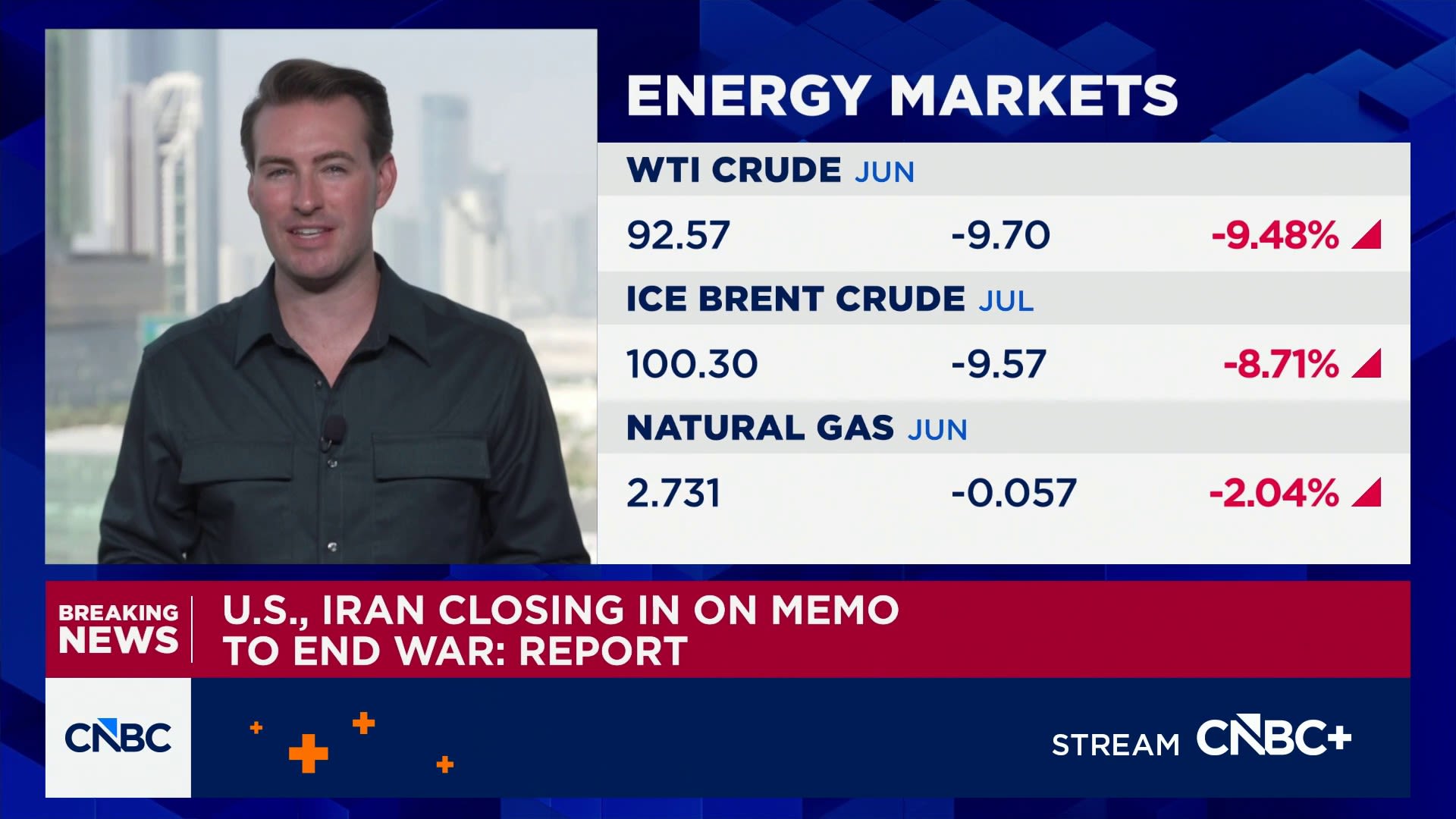
Trump posted after Axios reported that the U.S. and Iran were close to a one-page, 14-point memorandum of understanding that would end the war and establish a framework for further negotiations.
Washington expects responses from Tehran on “several key points” in the next 48 hours, Axios reported early Wednesday.
Stock indices jumped and oil prices plunged on the news, which appeared to be one of the strongest signals yet that and end to the more-than-two month war was coming into focus.
But Trump told The New York Post later Wednesday that it is still “too soon” to start thinking about another round of in-person peace talks with Iran.
Trump also told PBS News that the war has a “very good chance of ending,” but added, “if it doesn’t end, we have to go back to bombing the hell out of them.”
At an event Wednesday celebrating Mother’s Day with military families, Trump told reporters Iran wants to reach an agreement to end the war.
“We’re dealing with people that want to make a deal very much, and we’ll see whether or not they can make a deal that’s satisfactory to us,” he said.
Later, in the Oval Office, Trump said that the chairman of Exxon Mobil was at the White House on Tuesday, “along with a lot of them, Chevron, they were all here last night.”
They talked about Venezuela, the oil-rich South American nation that the military U.S. intervened in in early January by capturing the country’s president, Nicolás Maduro.
“They all want to go there and elsewhere,” Trump said of the oil companies. He did not say whether they discussed Iran or the Strait of Hormuz, the vital oil-shipping route whose de facto closure amid the war has caused a global energy supply shock.
Iranian Foreign Ministry spokesperson Esmaeil Baqaei told news outlets Wednesday that Tehran is still reviewing the proposal and would present its response to mediators in Pakistan.
In an X post published after Trump’s Truth Social statement, Baqaei appeared to cite the International Court of Justice, writing, “The concept of ‘negotiations’ requires, at the very least, a genuine attempt to engage in discussions with a view to resolving the dispute (ICJ, Judgement of 1 April 2011, para. 157).”
“It needs ‘good faith’, then, meaning that ‘negotiations’ is not ‘disputation’; nor is it ‘dictation’, ‘deception’, ‘extortion’ or ‘coercion,'” Baqaei wrote.
Iran’s foreign minister Abbas Araghchi, who was meeting Wednesday with his Chinese counterpart Wang Yi, said both Tehran and Beijing “reaffirmed Iran’s right to uphold national sovereignty national dignity.” In a post on X, Araghchi said “Iran trusts China,” adding that he looks forward to strengthening the strategic partnership between the two countries.
Before Trump’s post Wednesday morning, a Pakistani government official told MS NOW, “The prospect of a proposal to end the war is very likely in the coming days.”

Axios’ report said the memo being considered would involve Iran committing to a moratorium on nuclear enrichment, the U.S. lifting sanctions on Iran and both parties retreating from controls on ship transits through the Strait of Hormuz.
Many of the terms are reported to be contingent on a final agreement being reached between the two countries’ delegations.
A ceasefire between the U.S. and Iran has been in place since April 7 to allow for negotiations, but the break in hostilities has often looked fragile.
Earlier this week, Iran attacked U.S. forces that were helping commercial vessels transit the Strait of Hormuz, and launched fresh attacks on the United Arab Emirates. The U.S., meanwhile, said it sank six small Iranian boats that attempted to interfere with commercial ships moving through the waterway.
U.S. Central Command said in an X post Wednesday that it disabled an Iran-flagged unladen oil tanker that was attempting to sail toward an Iranian port — in violation of an ongoing U.S. blockade — by shooting it with “several rounds” from a cannon gun.
Optimism for an end to the conflict had resurfaced on Tuesday when Trump said he was pausing “Project Freedom” — the U.S. military’s operation aimed at guiding ships out of the Strait of Hormuz — a day after it began to see whether a peace deal could be finalized.
“Great Progress has been made toward a Complete and Final Agreement” with Iran, Trump wrote in a Truth Social post Tuesday night.
Source – Middle east monitor