Workers protest against pension changes and low wages
Government urged to improve protections and living standards
PUBLISHED : 24 Apr 2026 at 21:13
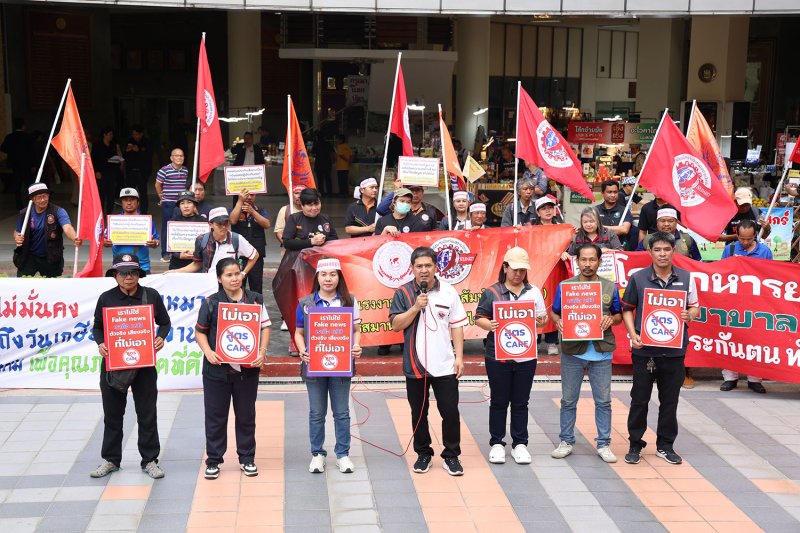
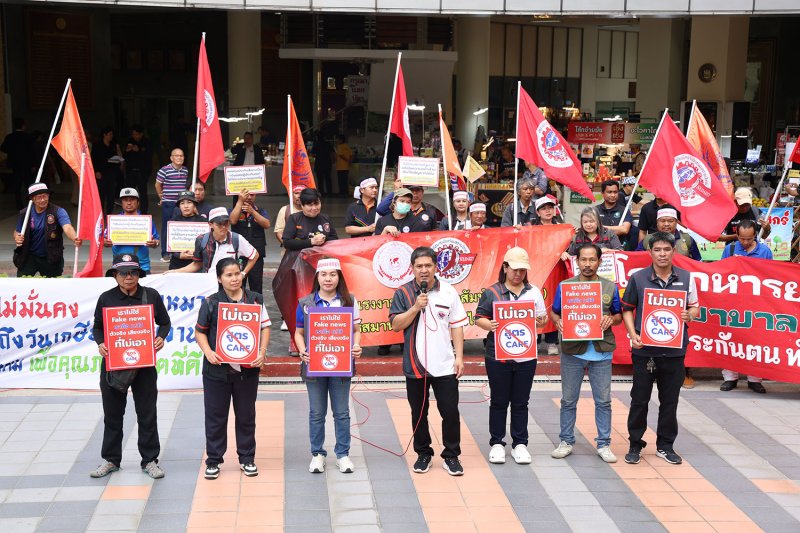
Workers’ groups groups rallied at the Ministry of Labour on Friday to protest against planned changes in the way pensions are calculated and to press for a higher minimum wage amid rising living costs.
Workers — who make up a large portion of Thailand’s population — have not seen genuine commitment from the government to address their hardships, said Sawit Kaewwan, president of the Thai Labour Solidarity Confederation (TLSC).
TLSC members joined the State Enterprise Workers’ Relations Confederation, the Thai Social Democratic Party and other citizens in calling for improved living standards for workers and opposing policies they consider useless.
Mr Sawit outlined several key demands, including opposition to any reduction in social security contributions, support for raising the minimum wage in line with rising living costs, an end to insecure forms of employment, and rejection of the proposed “Care” pension formula, which workers argue has not been adequately revised.
Proponents have said that the Care — Career Average Revalued Earnings — model would address long‑standing inequities in the current pension system, which bases benefits on earnings from the final 60 months of employment. They say this method no longer reflects modern labour patterns, particularly for older workers facing income volatility or frequent job changes.
Under the proposed system, pensions would instead be calculated using lifetime average earnings, adjusted to present value.
Labour Minister Julapun Amornvivat has acknowledged that about 200,000 people could be adversely affected under the new formula.
Consequently, he said, appropriate remedial measures must be in place so that no one is left behind.
Social Security worries
Mr Sawit criticised proposals to reduce social security contributions, warning that such measures would weaken the long-term stability of the Social Security Fund, which has come under intense scrutiny for its management of members’ money.
He suggested alternative solutions, including settling the government’s outstanding contributions of around 40 billion baht, increasing the state’s contribution rate to match or exceed those of employers and employees, and allowing contribution reductions only if the government makes contributions in place of workers.
Mr Sawit also argued that the Care formula could disadvantage low-income workers, as calculations indicate they would receive lower benefits than under the current system. He urged the government to retain the existing formula for now.
Turning to wages, he stressed the urgency of raising the minimum wage — currently between 337 and 400 baht per day — amid rising fuel and living costs, citing previous proposals ranging from 492 to 712 baht per day.
Source – Bangkok News