
Environmental groups embrace AI despite impacts

WASHINGTON – Environmental groups worldwide are using artificial intelligence to analyse climate data, track forest fires and count endangered wildlife — embracing a technology that they also warn is driving a surge in electricity demand, water use and greenhouse-gas emissions.
The contradiction is forcing these organisations to justify their AI use in carrying out missions to combat climate change or protect natural resources.
“We recognise that AI can come with environmental costs, and we need to be thoughtful about how we use it,” said Ali Swanson, AI lead at the US nonprofit Conservation International.
“But at a time when the climate and biodiversity crises are becoming more urgent, AI can help us move faster and make better use of the information we’re collecting.”
The group recently started using AI to assess hotspots detected by satellites and send real-time alerts to community forest patrols about potential wildfires in remote and environmentally sensitive parts of Cambodia.
Reuters interviewed 15 major environmental, conservation and development organisations about their AI use. All said they used the technology in some form and expressed concern about the environmental impact of the data centres powering it. The centres, filled with servers, can require vast amounts of electricity, along with water for cooling.
It’s a global dilemma for individuals, governments and industries balancing AI’s benefits with its enormous risks. The tradeoffs likely will grab attention at the UN’s COP31 climate conference this month, when host Turkey will call on governments, businesses and other institutions to sign a pledge outlining principles to ensure AI is developed and deployed sustainably.
UN Secretary-General Antonio Guterres wants major AI companies to publicly disclose their systems’ environmental impacts.
Researchers at the United Nations University Institute for Water, Environment and Health estimate the global data-centre footprint could more than double by 2030, reaching a size about twice that of Jakarta, the Indonesian megalopolis.
The International Energy Agency, meanwhile, estimates global data centres will consume about 945 terawatt-hours of electricity annually by 2030, producing the equivalent of more than 300 million tonnes of carbon dioxide. That’s double current consumption and about equal to Japan’s annual electricity use.
The agency also projects that global data centre water consumption will increase from about 560 billion litres in 2023 to about 1.2 trillion litres (317 billion gallons) annually by 2030.
Technology giants including Microsoft, Amazon and Google have reported rising emissions linked in part to data centre expansion, raising questions about their ability to meet their own long-term climate goals.
Amazon told Reuters its artificial-intelligence products were among the most sustainable due to the company’s purchases of low-carbon energy and its efforts to use power and water efficiently. (Story continues below)
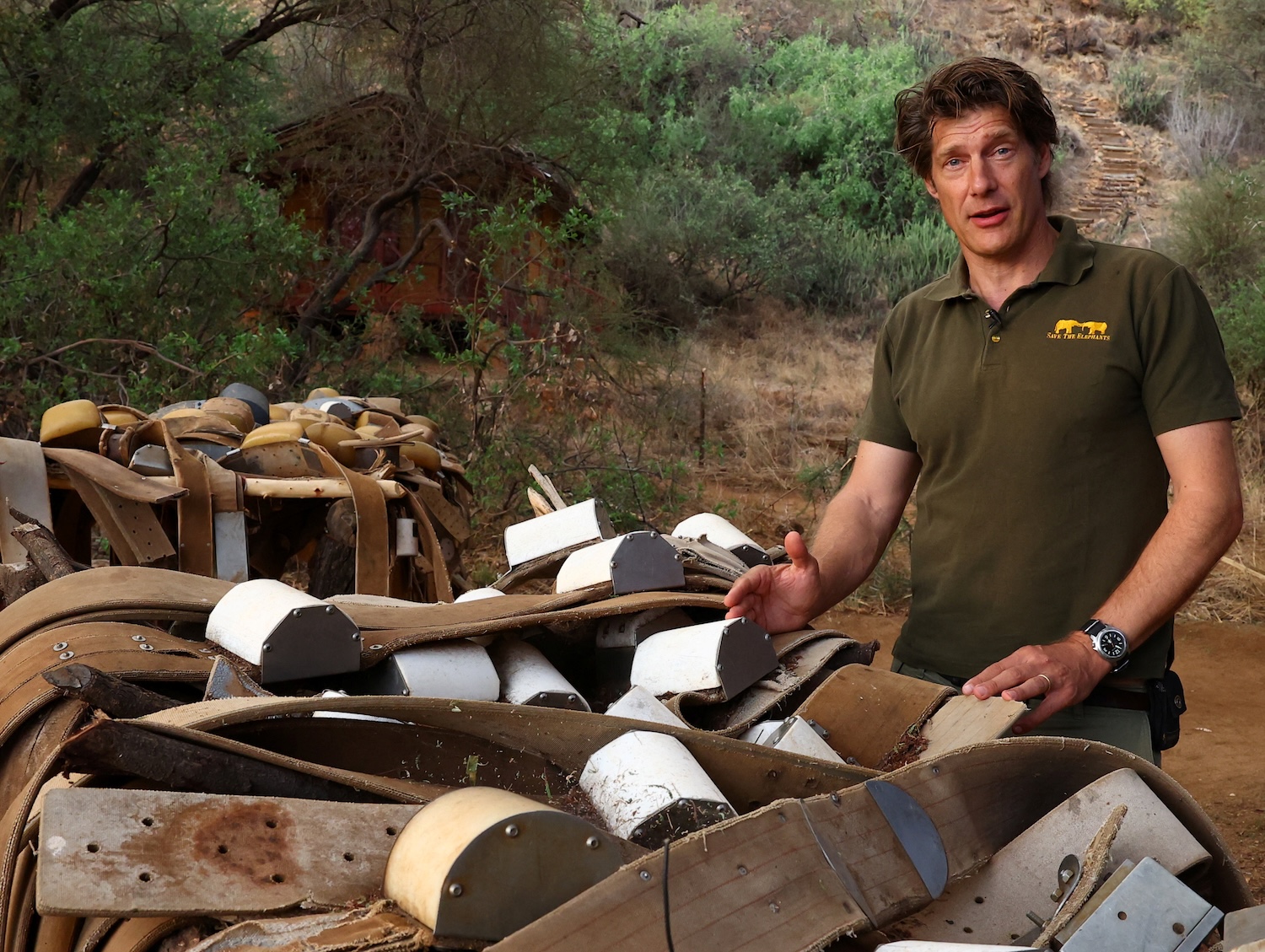
Frank Pope, chief executive of Save the Elephants, stands next to obsolete elephant tracking collars at the group’s research centre. He says an aerial survey last year generated 200,000 images that took nine people nine months to review manually. AI models can now complete similar analyses in hours. (Photo: Reuters)
Breakthroughs once thought impossible
Many of the organisations that spoke to Reuters believe AI’s benefits currently outweigh its costs because the technology is enabling work that was previously difficult, expensive or impossible.
Kenya-based Save the Elephants, a partner of the Wildlife Conservation Network, said it is using machine learning to improve population surveys and study elephant communication.
Frank Pope, the group’s chief executive, said an aerial survey of Kenya’s largest protected area last year generated roughly 200,000 images that took nine people nine months to review manually. AI models trained on Nvidia’s GeForce graphics platforms can now complete similar analyses in hours.
“The results have been eye-opening,” Pope said. “We found that human surveys were missing about a third of the elephants, roughly half of zebras and giraffes, and three-quarters of oryx populations.”
More accurate wildlife data can help secure financing for conservation, he said.
“Ultimately, these tools make nature measurable and therefore investable,” he said. “That’s a critical transformation, if we’re going to conserve biodiversity at scale.”
At the institute founded by the late conservation icon Jane Goodall, researchers are using AI to digitise decades of field notes about chimpanzee behaviour in Tanzania’s Gombe National Park.
The project was once expected to take 13-15 years because the records were written by hand using the local Kiha language and scientific shorthand.
Thanks to a tool developed with Amazon Web Services, the notes can now be scanned, translated and structured in minutes, slashing the time needed to about two years, said Lilian Pintea, the Jane Goodall Institute’s vice president of conservation science.
During her lifetime, Pintea said, Goodall supported the use of AI to advance conservation science, provided people remained firmly in control of how it was used.
“AI technology should be seen as tools which are human-centred,” Pintea said.
Limiting the impact
Some organisations are experimenting with ways to limit the environmental impact of their AI use.
The World Resources Institute (WRI), a research group that uses AI to accelerate its climate and environmental analyses, said it limits resource-intensive applications such as generating videos and images, while caching AI query results so identical searches don’t need to be reprocessed.
The US-based Nature Conservancy has adopted a similar approach. It uses AI to analyse video captured on commercial fishing vessels for information on how many fish of different species they catch.
But instead of uploading huge numbers of videos to centralised data centres, it has installed AI-powered digital cameras to process information aboard the vessels, reducing energy use and data-transfer requirements, said Vienna Saccomanno, a senior scientist at the organisation.
“It takes a lot of engineering to make computation on the edge possible,” she said. “This was worth it to reduce both our carbon footprint and deliver these sustainability insights.”
Greenpeace International said it, too, uses some AI tools, mainly because software platforms it relies upon include AI features.
It’s imposing internal guidelines emphasising transparency, human oversight and “intentional” AI use, the group said. But it would prefer to sidestep the technology due to its environmental impacts and is pushing back hard on the data centre buildout.
“While other organisations are asking how to use AI responsibly, Greenpeace is asking whether it’s necessary to build all these massive data centres in the first place,” said Katrin Xueying Wu, a climate and energy campaigner with the organisation.
Other groups now see AI as vital to effective environmental activism.
“It’s our job to save the planet. If we can do that more effectively and efficiently with the limited resources we’ve got by using AI, then we have to seriously engage in that possibility,” said Stuart Butchart, chief scientist at UK-based BirdLife International.
“If we don’t do it, then we’re sort of being derelict in our duty.”
Source – Bangkok News